


Steering out of the Storm: Swiftly and Forcefully
EU-Taiwan Partnership during Turbulent Times
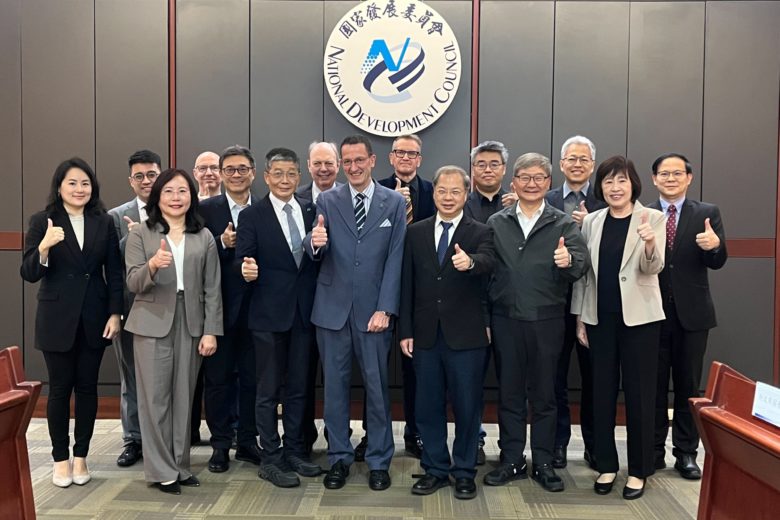
Taipei, 26 November 2008 - The European Chamber of Commerce Taipei (ECCT) released its 2008-2009 Position Papers today. The first copy of the Position Papers was presented to the cabinet level Council for Economic Planning and Development (CEPD), represented by Vice Chairman Sam Gee at the ECCT’s November Monthly Members’ Luncheon. After the luncheon, results were presented to the media at a press conference.

The theme of this year’s Position Papers, Steering out of the Storm: EU-Taiwan Partnership during Turbulent Times reflects the view of the European Chamber that a stronger partnership between Taiwan and European business would help considerably to weather the global economic crisis that is affecting all economies including Taiwan and the EU. The 2008-2009 Position Papers state that given the severe economic conditions the Taiwan government will have to act swiftly to demonstrate firm and decisive leadership in executing economic reform to revitalize domestic consumption, strengthen business competitiveness and create jobs. For its part the ECCT, as the organisation representing the largest group of foreign investors in Taiwan, sees opportunity in this crisis and has therefore proposed a renewed economic partnership between Europe and Taiwan for the coming four years.
At a press conference ECCT Chairman Philippe Pellegrin lauded the recent breakthrough in cross-Strait relations culminating in the historic meeting in early November between PK Chiang, Chairman of Taiwan’s Straits Exchange Foundation (SEF) and Chen Yun-lin, Chairman of China’s Association for Relations across the Taiwan Strait (ARATS). “The SEF-ARATS summit is of great historical significance and the four agreements signed between the two sides are an important step towards normalizing cross-Strait business ties,” he said. He went on to say that despite the current critical economic conditions and the consequent challenges ahead, the historic breakthrough in cross-straits economic and political relations has given Taiwan renewed business potential, to fully capitalize on its strategic location, its competitive high-tech industrial base, and its talented human resources. However, Pellegrin stressed that the meeting should be seen as a first step only. “There is much more to be done and the two sides should move swiftly to fully normalize cross-Strait business relations, especially in the areas of the free movement of people and goods, lifting remaining financial restrictions and the ban on the importation of goods from China,” he added.
The ECCT recognizes that the cabinet has ambitious plans to put the economy back on track, but the implementation should be swift and forceful. Chairman Pellegrin reminded the government that past economic success does not guarantee success for the future and that the environment has changed dramatically since the 1990s: China has emerged as the world’s third largest economic power and neighboring markets such as Hong Kong, Singapore and South Korea have strengthened their competitiveness in becoming regional service hubs in logistics, operations and financial services. “The economic challenges and remedies differ substantially from those of the past and the cabinet should execute economic policies that are built on the current economic realities,” Pellegrin stressed.
Given turbulent times and the great urgency for the government to set economic policy priorities, this year’s Position Papers offer the ECCT’s suggested set of economic policy priorities for the Taiwan government. Furthermore, the ECCT proposes a renewed economic partnership between Taiwan and Europe that can bring bilateral trade and investment to the next level. European firms have long recognized the importance of Taiwan not only as a technological product and component manufacturer, a strong market in its own right but also as an important partner and stepping stone for European firms going into China. The suggested policies therefore, together with the effects of a proposed EU-Taiwan Trade Enhancement Measures (TEM) agreement are expected to boost domestic consumption and thus reduce the negative impact from the impending global recession.
Suggested priority policies and measures:
1. Capitalize on cross-straits achievements
In the last six months the Taiwan government has made significant progress in normalizing cross-straits relations: direct flights were established, PRC tourists are allowed to visit Taiwan, a 40% cap on PRC investments was eliminated and restrictions on China shares in global funds sold in Taiwan have been eased. The elimination of these restrictions has created renewed interest and opportunities for European businesses to partner with Taiwanese companies, using Taiwan as a stepping stone into mainland China or other markets such as Vietnam with major Taiwanese investments. The ECCT encourages the government to capitalize on these achievements and seize the momentum to negotiate and implement the following policies that allow full cross-straits economic normalization:
• Eliminate restrictions and further streamline the business visa process for PRC nationals.
• Allow operations of direct cargo flights and sea freight.
• Lift the import ban on all products manufactured in Mainland China.
2. Bold tax reforms – Welcome tax payers back!
The cabinet needs to implement much bolder tax reforms, or else accept continued capital outflow and losing out to rivals Hong Kong, Singapore and even South Korea in becoming a financial center. Priority should be given to implement the following measures:
• Lower personal income and corporate tax rates to levels of competing markets like Hong Kong and Singapore.
• Exempt overseas securities gains from personal income tax calculations in Taiwan.
• Reform withholding tax policies on overseas services and stringent deduction criteria for insurance premiums paid overseas.
3. Conform to international standards – Consumer health, safety & choice!
The Taiwan government needs to fully adopt international standards and practices in regulating the licensing, sales and distribution of products and services in Taiwan. The victim is the Taiwan consumer by having to pay higher product prices and having less product choice due to the higher compliance costs for manufacturers and importers; by being pressed into overseas banking services due to the restrictions on financial service products offered domestically; and by not getting full access to the latest innovative medicines, including those that treat life-threatening diseases.
Moreover, Taiwan-only requirements continue to obstruct Taiwan’s service industry development and form non-tariff barriers for European manufacturers and importers. Adopting international standards protects the health and safety of consumers, while providing them a larger choice of high-quality products. Priority should be given to implement the following measures:
• Adopt international standards for product hygiene & safety.
• Simplify and shorten approval procedures for financial service products.
4. Open up public procurement – Build a world-class infrastructure!
The government’s proposed i-Taiwan 12 major infrastructure projects promise to provide a boost to the economy. However, the current regulatory environment encourages state-owned enterprises and government entities to restrict or discourage foreign companies from participating in construction projects with the consequence that many European companies refrain from bidding for projects due to the unfavorable risk allocation of tender projects. Priority should be given to implement the following measures:
• Prioritize efforts to become a signatory to the Government Procurement Agreement (GPA).
• State-owned enterprises should comply with the spirit of GPA.
• Implement attractive and realistic local content requirements.
5. Drive energy efficiency, innovation and environmental conservation – Go green!
The Taiwan government needs to take bold and forceful measures that effectively encourage the more efficient use of energy and stimulate innovative technologies in Taiwan. Facing the threat of climate change and dwindling resources, eco-technologies - such as renewable energies and environmentally-friendly materials and closed loop manufacturing technologies - are some of the world's fastest growing industries. All industrial sectors will eventually have to incorporate energy and material efficiency, environmentally-friendly design, clean production techniques and ever stricter environmental standards. Priority should be given to implement the following measures:
• Increase the energy efficiency of existing power plants and distribution networks.
• Encourage material efficiency and energy saving and stimulate the use of renewable energy to consumers and industry alike.
• Introduce incentive programs and regulations to create a sizeable domestic market for Photo-Voltaic (PV) applications (such as a feasible in-feed tariff system).
• Strengthen the existing "Green Building guidelines" to include all buildings with regulations on insulation values and energy consumption. Energy efficiency in building design offers the best solution for energy saving and significant green house gas reductions.
• Instate a single institution to coordinate among different government agencies the setting of CO2 emission standards and fuel efficiency regulations.
EU-Taiwan Partnership through a Trade Enhancement Measures (TEM) agreement
Although European companies are large investors in Taiwan, EU-Taiwan bilateral trade and investment is lagging behind those between the EU and other Asian markets (Taiwan ranks as the EU’s 5th largest trading partner in Asia). The negative impact from the lack of cross-strait economic relations in the last decade was a major factor, but equally important has been the existence of substantial tariff and non-tariff barriers between the two economies. Hence, in January 2008 the ECCT commissioned Copenhagen Economics, a leading consultancy in bilateral trade relations, to conduct a study measuring the impact that an EU-Taiwan trade enhancement measures (TEM) agreement would have for both the Taiwan and European economy. Such TEM measures would partially or fully eliminate the remaining tariff and non-tariff barriers between Europe and Taiwan, in particular those impacting the service industries.
The study’s findings reveal that such measures would boost the annual EU GDP by €2 billion, creating more European jobs and expanding production output. European exports to Taiwan would increase by €11.8 billion within a period of two to five years, in particular benefiting EU manufacturers of goods such as motor vehicles (€1.6 billion in additional exports per year), electronics & machinery (€1.7 billion in additional exports), but also in beverages, clothing and textiles. The largest gains for European industries would be in services, including business services such as engineering (€2.0 billion in additional gains), transport services such as marine transport and express delivery, trade services such as retail & wholesale trading, and financial services such as banking and insurance.
With regard to the benefits for the Taiwan economy, the TEM measures would boost its annual GDP by €3.8 billion, or about 1 percentage point. Taiwanese exports to Europe would increase by €9.84 billion, in particular benefiting Taiwanese manufacturers of electronics and machinery (€4.8 billion in additional exports per year), other manufacturing (€1.7 billion in additional exports per year) including textiles and clothing (€0.7 billion in additional exports per year). Taiwanese service providers would benefit in particular transport services such as shipping (€0.7 billion in additional exports per year).
The study further shows that in this potential “deal” the EU would gain from better market access in services through the removal of non-tariff barriers. The reduction of service barriers would also help Taiwanese manufacturers as they would gain better access to cheaper, high level services. Taiwan would gain from duty free access to the EU market on similar conditions as Korea, which is mainly helping to expand Taiwan’s exports of electronics, but it would in turn also benefit European manufactures that supply intermediate electronic components and materials to Taiwanese industries. Finally, the study suggests that with continued cross-Strait economic normalization, Taiwan is a stepping stone into China for European businesses. Open trade between the EU and Taiwan would substantially increase European business opportunities both in Taiwan, China and other neighboring countries with a strong Taiwanese business presence (e.g. Vietnam).
|